
An AI model can generate code. An AI coding harness enables that model to perform software work inside a real development environment.
The harness provides the context, tools, execution loop, permissions, tests, and feedback that connect model output to a repository. It may allow an agent to inspect files, run commands, modify code, start an application, read logs, execute tests, and prepare a pull request. It also determines what the agent is not allowed to do.
This distinction explains why comparing coding systems only by model benchmarks can be misleading. The model matters, but production results depend heavily on the engineering system around it.

A Simple Definition of an AI Coding Harness
An AI coding harness is the orchestration and control layer surrounding an AI model during software development.
It typically performs six jobs:
- Builds the context the model needs for the current task.
- Translates model decisions into tool calls and repository actions.
- Runs the agent through a repeatable planning and execution loop.
- Restricts access through permissions, isolation, and approval gates.
- Validates changes with tests, linters, builds, and other checks.
- Preserves progress and feedback across multiple steps or sessions.
The word “harness” is useful because it describes both enablement and control. A climbing harness allows movement while limiting the consequences of a fall. A coding harness gives an agent useful capabilities while keeping its actions observable and bounded.
Model, Coding Agent, and Harness Are Not the Same Thing
These terms are often used interchangeably, but they describe different layers.
| Layer | Main responsibility | Example output |
|---|---|---|
| AI model | Interprets input and generates a response | A proposed code change or next action |
| Coding agent | Pursues a goal over several steps | Searches files, edits code, and runs a test |
| Agent harness | Connects the agent to context, tools, execution, permissions, and feedback | A controlled end-to-end development loop |
| Engineering system | Defines architecture, CI/CD, observability, ownership, and production operations | A maintainable product and accountable release process |
A powerful model inside a weak harness may receive poor context, use tools inefficiently, or stop before verifying its work. A less capable model inside a disciplined workflow may perform better on a narrow, well-specified task.
The harness does not eliminate the need for engineering. It is an engineering product itself.
The Core Components of a Coding Harness
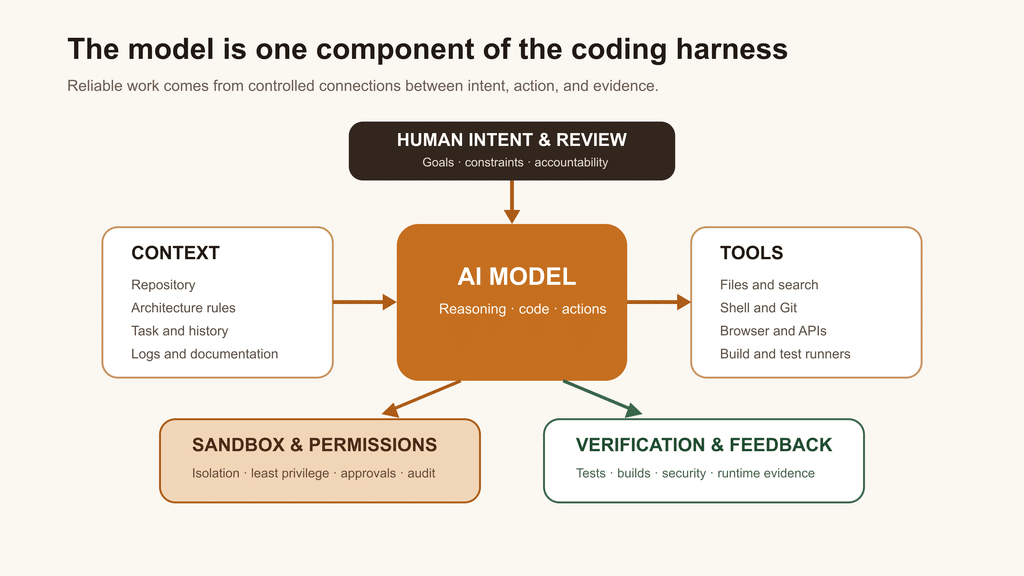
1. Context Construction
A repository may contain thousands of files, years of history, several services, and multiple sources of documentation. Sending everything to the model is expensive and often counterproductive. Sending too little causes incorrect assumptions.
The harness must help the agent retrieve the right information at the right time:
- repository structure;
- relevant source files and dependencies;
- architecture and coding standards;
- task description and acceptance criteria;
- recent changes and version-control history;
- test failures, logs, and runtime evidence;
- project-specific instruction files.
Good context is not simply more context. It is current, relevant, prioritized, and clearly separated from untrusted input.
2. Tools and Action Interfaces
The model cannot change a repository by describing a change. The harness exposes tools that turn decisions into actions.
Common tools include:
- file search, reading, and editing;
- shell and package-manager commands;
- Git operations;
- build systems, linters, and test runners;
- browser or UI automation;
- issue trackers and pull-request systems;
- documentation and API retrieval;
- logs, metrics, and tracing systems.
Tool design affects reliability. Clear, bounded tools are easier for an agent to use correctly than broad interfaces with ambiguous behavior. Tool output must also be treated carefully because external pages, issue descriptions, logs, and repository files can contain misleading or malicious instructions.
3. The Agent Loop
A coding harness repeatedly connects reasoning with evidence:
- Understand the task and inspect the current state.
- Form a plan appropriate to the risk and scope.
- Make a bounded change.
- Run relevant checks.
- Interpret the result.
- Correct failures or reassess the plan.
- Summarize the completed work and remaining uncertainty.
This loop is more important than a single impressive response. Professional development is iterative. The agent must be able to discover that its first assumption was wrong and use test or runtime evidence to change direction.
4. Sandboxing and Permissions
A useful coding agent may need to run code, install dependencies, access the network, or interact with deployment systems. Those capabilities create risk if they are unrestricted.
A harness should apply least privilege:
- isolate work in a dedicated workspace, branch, container, or virtual machine;
- restrict writes to the intended project;
- limit network access and external destinations;
- keep secrets outside the agent’s readable context;
- require approval for sensitive or irreversible actions;
- record commands and changes for review;
- separate development access from production access.
Sandboxing is not merely a safety feature added after implementation. It defines the boundary within which useful autonomy is possible.
5. Verification and Feedback
The harness needs objective signals that are harder to satisfy accidentally than a conversational instruction.
Examples include:
- unit and integration tests;
- type checking and linting;
- security and dependency scanning;
- build verification;
- browser-based acceptance tests;
- performance budgets;
- architectural dependency rules;
- code review and approval policies;
- production logs, metrics, and traces.
Passing checks does not prove the feature is correct if the checks are incomplete. A dangerous pattern is asking the same agent to implement sensitive behavior, write all tests for that behavior, and declare success without independent criteria.
Strong teams define invariants that apply regardless of how the code is written. Examples include “every administrative action requires authorization,” “API inputs are validated at the boundary,” or “changes cannot introduce dependencies between these architecture layers.” The harness then makes those rules executable.
6. State, Memory, and Long-Running Work
Complex work may span hours, multiple context windows, or several agents. The harness needs a way to preserve useful state without allowing stale or untrusted information to silently control future work.
Useful artifacts include:
- a written implementation plan;
- a list of completed and remaining tasks;
- test results;
- a concise decision log;
- commits or checkpoints;
- reproducible startup and verification commands;
- links to relevant issues and pull requests.
The goal is not perfect conversational memory. It is durable, inspectable project state that a developer or another agent can verify.
Why the Same Model Produces Different Results
Businesses often evaluate tools by asking which model is “best at coding.” That question is incomplete.
Results can change significantly based on:
- how the task is decomposed;
- which files are retrieved;
- whether architecture rules are explicit;
- whether the agent can run the application;
- how fast it receives test feedback;
- which actions require approval;
- whether failures are visible through logs and traces;
- how much irrelevant information occupies the context;
- whether progress survives a long session;
- how quality is evaluated before merge.
OpenAI’s published harness-engineering experience describes engineers shifting toward specifying intent, building tools, exposing runtime evidence, and creating enforceable feedback loops. Anthropic’s work on long-running agents similarly emphasizes incremental progress, persistent artifacts, and reliable verification rather than asking a model to build an entire application in one attempt.
The lesson is vendor-neutral: dependable agentic development is a systems problem, not only a model-selection problem.
Research published in 2026 helps quantify why this systems layer matters. An NBER study using data from more than 500,000 GitHub developers found that autonomous coding agents were associated with a cumulative 240% increase in commits, but only an 80% increase in projects and a 30% increase in releases. Generating changes scaled much faster than shipping complete software. A harness addresses that gap by connecting generation to review, integration, testing, and release controls rather than treating the commit as the finished product.
A controlled 2026 IEEE study found that AI-assisted participants achieved more than twice the median task completeness, while scoring 12.5% lower when answering technical questions about the code they had produced. That does not argue against coding agents. It argues for workflows that require explanations, independent checks, small reviewable changes, and clear human ownership.
Security research published in 2026 found that newer models could detect and repair roughly 75-80% of the examined vulnerabilities when explicitly prompted, but they still missed issues and sometimes gave incorrect conclusions confidently. A harness turns that limitation into an engineering requirement: model review should be supported by static analysis, tests, policy checks, and qualified human review rather than trusted as the final authority.
A Reference Workflow for AI-Assisted Development
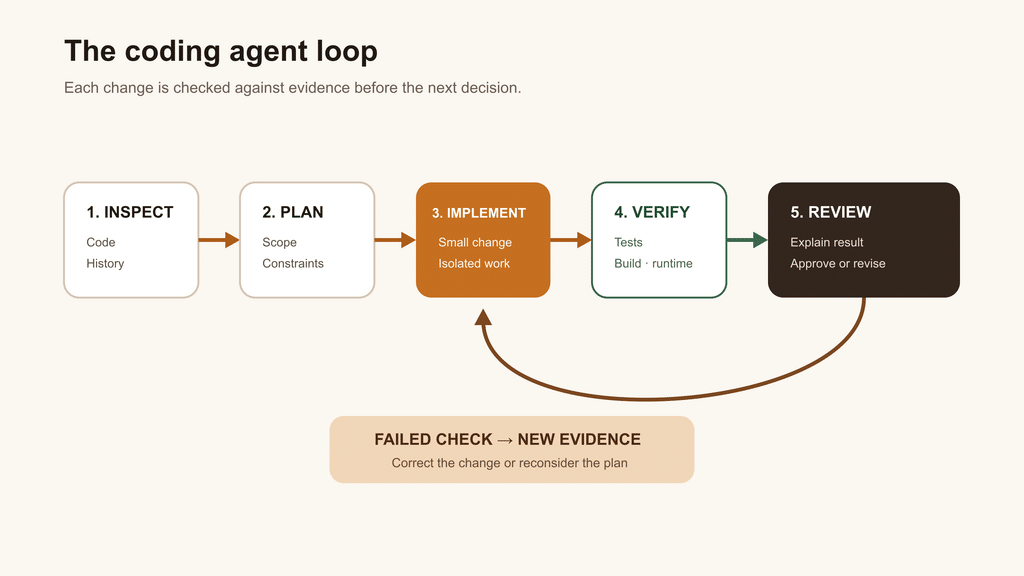
A practical harness workflow can look like this:
| Stage | Agent responsibility | Human or system control |
|---|---|---|
| Scope | Restate the goal and identify affected areas | Product owner confirms acceptance criteria |
| Inspect | Search code, history, documentation, and tests | Context boundaries prevent irrelevant or sensitive access |
| Plan | Propose a sequence of bounded changes | Developer reviews high-risk assumptions |
| Implement | Modify code in an isolated branch or workspace | Permissions restrict the blast radius |
| Verify | Run tests, linting, builds, and application checks | Independent CI and security policies enforce standards |
| Review | Explain changes, tradeoffs, and unresolved risk | Human or separate review agent challenges the result |
| Release | Prepare a traceable deployment artifact | Approval, monitoring, and rollback controls remain in place |
This workflow can be shortened for a low-risk documentation change and strengthened for authentication, payments, regulated data, infrastructure, or production migrations. The control level should follow business impact.
What a Harness Cannot Solve by Itself
A good harness improves reliability, but it cannot compensate for every organizational weakness.
It cannot define a coherent product strategy when stakeholders disagree. It cannot create meaningful acceptance criteria from a vague request without making assumptions. It cannot guarantee security when the organization has no threat model. It cannot keep architecture clean if no boundaries exist. It cannot determine whether a feature creates customer value from code alone.
Most importantly, it does not create accountability. People still decide what the agent may do, which evidence is sufficient, and when a change is ready for customers.
This is why replacing engineers with access to a coding model is a false economy. The safer and more productive approach is to let engineers design and operate the harness that multiplies their capabilities. For the business perspective, read Why Replacing Software Developers with AI Is Risky for Business at `/blog/why-replacing-software-developers-with-ai-is-risky/`.
How to Evaluate an AI Coding Harness
Before adopting a platform or building an internal workflow, evaluate it across five areas.
Context Quality
Can the system find relevant code and instructions without exposing unnecessary secrets or flooding the model with unrelated information?
Tool Reliability
Are tools explicit, observable, and limited in scope? Can commands be reproduced by a developer outside the agent session?
Security Boundaries
Can the agent work in isolation? Are network access, credentials, production systems, and destructive actions appropriately restricted?
Verification Depth
Can the agent run the real build, tests, and application? Are security, architecture, and performance controls enforced independently?
Operational Fit
Does the workflow integrate with the team’s repository, issue tracking, code review, CI/CD, monitoring, and incident response? Can the organization measure outcomes rather than demonstrations?
Building Harness-Friendly Software
AI agents work better when a codebase is understandable and feedback is fast. Many of the practices that help agents also help human developers:
- keep modules focused and boundaries explicit;
- store important project rules close to the repository;
- make local setup reproducible;
- maintain fast, deterministic tests;
- provide clear error messages and structured logs;
- automate formatting and static analysis;
- keep changes small and reviewable;
- document architectural decisions and operational procedures;
- make deployments observable and reversible.
This is an important strategic benefit of adopting AI responsibly. The effort to make a system legible to agents often exposes weaknesses that were already slowing the engineering team.
Start with a Bounded Workflow
A business does not need a fully autonomous software factory to benefit from harness engineering.
A sensible first implementation is one repeatable, low-risk workflow such as:
- investigating a bug and proposing a patch;
- upgrading approved dependencies;
- generating and validating routine tests;
- updating documentation after an API change;
- refactoring code under existing test coverage;
- preparing a pull request for human review.
Define the inputs, permissions, expected artifacts, automated checks, escalation conditions, and owner. Measure cycle time, review effort, defect rate, and successful completion. Expand autonomy only when evidence supports it.
The Harness Turns Capability into Engineering Work
The AI model is important, but it is not the complete development system. Reliable results come from the interaction between model capability, repository context, well-designed tools, controlled execution, objective verification, and engineering judgment.
For businesses, this means AI adoption should be treated as an engineering transformation rather than a software subscription. The goal is not to generate the maximum amount of code. The goal is to deliver valuable changes faster while keeping risk, ownership, and maintainability under control.
Five Bricks helps companies design and build modern web applications with AI-assisted engineering workflows, automated quality controls, and experienced technical oversight. Contact us if you want to evaluate where coding agents can safely accelerate your product delivery.
Frequently Asked Questions
It is the software and workflow around an AI model that supplies context, exposes tools, runs the agent loop, controls permissions, preserves state, and validates code changes.
No. The model generates decisions or content. The harness connects those decisions to files, commands, tests, external systems, and safety controls.
No. It can automate implementation and verification steps, but developers and product owners still define intent, architecture, risk tolerance, approval criteria, and responsibility for production outcomes.
Tests provide concrete feedback that allows an agent to detect and correct failures. They are most useful when acceptance criteria are independent and the agent cannot weaken existing tests merely to make a change pass.
Not by default. Access should follow least privilege, with isolation, auditability, and explicit approval for high-impact actions. Most coding work can be completed in a development environment and released through existing CI/CD controls.