
Artificial intelligence can write code, generate tests, explain unfamiliar systems, and complete well-scoped development tasks faster than many teams could a few years ago. That does not mean a business can safely replace software developers with AI.
The more useful conclusion is less dramatic: AI changes how developers work. It does not remove the need for engineering judgment, product understanding, security ownership, or accountability. A capable developer using AI can move faster and spend more time on high-value decisions. An AI tool operating without competent oversight can produce a large amount of plausible code before anyone discovers that it solves the wrong problem.
For business leaders, the real decision is not whether to choose people or AI. It is how to combine experienced engineers, reliable AI tools, and effective controls so that higher development speed produces better business outcomes rather than faster technical debt.

AI Can Generate Code, but Software Development Is Larger Than Coding
Code is the visible output of software development, so it is easy to assume that faster code generation makes most of the developer’s role unnecessary. In practice, production software begins long before the first file is changed and continues long after a feature is deployed.
Developers and product teams must determine:
- what problem the business is actually trying to solve;
- which requirements are essential and which can wait;
- how the new feature fits the existing architecture;
- what data the system may collect, store, and expose;
- how permissions, failures, and unusual user behavior should be handled;
- how the change will be tested, deployed, monitored, and maintained;
- who is responsible when the system behaves incorrectly.
An AI model can help with every item on this list, but it does not independently own any of them. It predicts and produces an answer from the context it receives. If the context is incomplete, the output may still look confident and technically polished.
That difference matters. A function can be syntactically correct while the feature is commercially wrong. A test suite can pass while testing the wrong assumptions. An integration can work during a demo while failing under real traffic, expired credentials, duplicate events, or partial outages.
Why Full Developer Replacement Creates Business Risk
The Wrong Requirement Can Be Implemented Very Efficiently
AI is good at turning clear instructions into implementation. Many business requests are not clear instructions. They contain contradictions, missing edge cases, unspoken operational rules, and assumptions that different stakeholders interpret differently.
An experienced developer does not simply accept the request. They ask why the feature is needed, identify conflicts, expose dependencies, and translate business language into testable behavior. Removing that role can make the delivery process appear faster while increasing the probability of building the wrong thing.
Architecture Decisions Accumulate
Most architectural problems are not obvious in the first version of a feature. They emerge after months of additions: duplicated logic, unclear ownership, inconsistent data models, unnecessary dependencies, slow queries, and fragile integrations.
AI-generated code can follow a strong architecture when the repository makes that architecture explicit. Without those constraints, an agent may optimize for completing the current task rather than preserving the long-term coherence of the system.
The result is not necessarily bad code in isolation. It is a codebase made from individually reasonable changes that no longer form a maintainable whole.
Security Requires Independent Judgment
AI coding tools can suggest insecure dependencies, mishandle authorization, expose sensitive context, or interact with untrusted repository content. Agentic tools may also run commands, install packages, edit CI configuration, or access external systems.
This does not make AI unsuitable for secure development. It means generated changes must pass the same security controls as human-written changes, with additional attention to agent permissions, context exposure, prompt injection, and supply-chain risk.
Critical authentication, authorization, payment, privacy, and cryptographic code should not be accepted simply because generated tests pass. The person or team approving the change must understand the threat model and verify the behavior independently.
More Output Can Produce More Technical Debt
AI lowers the cost of producing code. It does not automatically lower the cost of understanding, operating, and changing that code.
If a team generates features faster than it can review architecture, validate behavior, update documentation, and monitor production, its backlog of hidden risk grows. The business experiences impressive short-term velocity followed by slower releases, regressions, and expensive rewrites.
This is why lines of code, number of pull requests, or number of completed tickets are poor measures of AI success. Useful measures include lead time, escaped defects, change failure rate, recovery time, customer adoption, and measurable business impact.
Accountability Cannot Be Delegated to a Model
When software blocks an order, exposes customer data, calculates a price incorrectly, or stops a critical workflow, the business cannot ask the model to accept responsibility. Someone must own the decision, investigate the failure, communicate with stakeholders, and make the tradeoff between speed, cost, and risk.
AI can support that person. It cannot replace organizational accountability.
The Evidence Is More Nuanced Than the Headlines
Research published in 2026 makes the business case more precise. Modern AI tools can increase coding output dramatically, but the increase becomes much smaller as work moves from generating code to releasing software that people actually use.
An NBER working paper, revised in September 2026, combined AI usage telemetry with data from more than 500,000 GitHub developers. It reported cumulative increases of approximately 30% in commits for autocomplete tools, 180% for interactive coding agents, and 240% for autonomous coding agents. Yet the 240% increase associated with autonomous agents fell to about 80% when measured as projects and 30% when measured as releases. The researchers concluded that human work remains strongly complementary to AI: review, coordination, product decisions, integration, and release processes can become the new bottlenecks.
A 2026 quasi-experiment involving programmers at Ant Group found a 22% increase in completed tasks, even after the researchers used task-based measures rather than relying only on lines of code. Most of the gain came from time saved elsewhere in the workflow, not from directly accepting AI-generated code. The effect was stronger for junior and entry-level programmers and more limited for senior developers. This supports a practical interpretation: AI creates leverage, while the developer still determines how that leverage is used.
Productivity also has a comprehension tradeoff. A controlled study published in IEEE Transactions on Software Engineering in 2026 found that participants using AI completed more than twice as much of the assigned tasks by the median measure. However, their ability to answer technical questions about the code was 12.5% lower. Faster completion is valuable, but a business still needs engineers who understand the implementation well enough to maintain it, investigate failures, and make the next change safely.
The quality evidence points in the same direction. A 2026 peer-reviewed security study found that newer models detected and repaired roughly 75-80% of the examined vulnerabilities, a major improvement over the earlier model tested by the researchers. They still missed issues, sometimes introduced vulnerabilities, and could present incorrect conclusions with confidence. A separate 2026 preprint analyzing 304,362 verified AI-authored commits across 6,275 GitHub repositories found that more than 15% of commits from each examined assistant introduced at least one detected issue, and 24.2% of tracked issues remained in the latest repository revision. Because that study is a preprint and relies on static analysis, its exact rates should be interpreted cautiously, but its operational lesson is sound: higher generation speed must be matched by stronger verification.
The 2025 DORA report remains useful organizational context. It describes AI as an amplifier of existing strengths and weaknesses, which is consistent with DORA’s 2026 guidance that faster generation must be supported by clear ownership, small batches, internal platforms, and fast feedback. The early-2025 METR experiment is also worth retaining as a historical baseline: experienced open-source developers working in mature repositories they already knew took longer with that generation of AI tools. It should not be treated as a measure of current frontier agents. Instead, it shows how quickly results can change with the model, interface, task, codebase, and surrounding workflow.
The current evidence therefore does not support either extreme. AI is neither ineffective nor an automatic replacement for an engineering team. It is highly effective at increasing implementation capacity, while the harder constraints increasingly move to specification, verification, architecture, integration, release, and ownership.
Where AI Makes Developers Faster
Used well, AI can remove substantial friction from software delivery.
Prototyping and Exploration
Developers can test an approach, generate an interface draft, explore an API, or compare implementation options before investing in a complete solution. This makes early discovery more concrete and reduces the cost of rejecting a weak idea.
Repetitive Implementation
Boilerplate, data transformations, CRUD operations, configuration, test fixtures, and routine migrations are strong candidates for AI assistance. The developer defines the pattern and verifies that generated variations follow it.
Testing and Review Support
AI can propose edge cases, generate initial unit tests, inspect a change for inconsistencies, and explain why a test failed. It is particularly useful as an additional reviewer, although it should not be the only reviewer for security-critical behavior.
Working in Unfamiliar Code
An agent can search a repository, trace dependencies, summarize modules, and locate the files involved in a workflow. This reduces orientation time, especially when the developer still validates the explanation against the actual code.
Documentation and Maintenance
AI can update documentation, generate migration notes, prepare release summaries, and help with systematic refactors. These tasks often receive too little attention because they compete with feature work.
The common factor is clear ownership. A developer frames the objective, supplies the relevant context, chooses the constraints, and checks the result.
The Better Model: Developer Plus AI
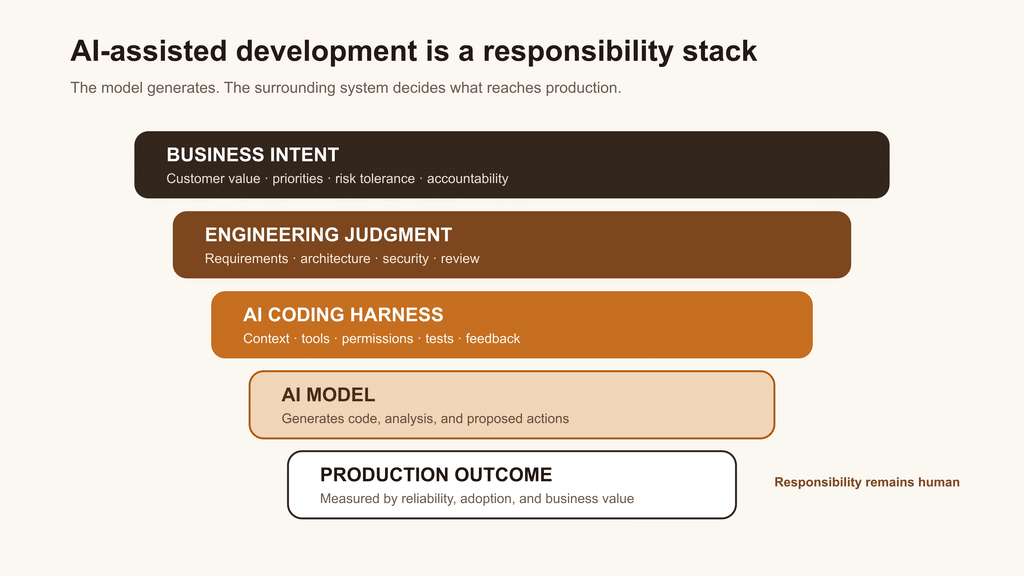
The role of a developer is moving upward in abstraction. Less time is spent manually typing predictable code. More time is spent defining intent, designing boundaries, selecting tools, reviewing changes, evaluating risk, and improving the environment in which AI operates.
| Traditional emphasis | AI-assisted emphasis |
|---|---|
| Writing each implementation line | Specifying behavior and constraints |
| Searching manually across the repository | Directing and validating repository analysis |
| Producing repetitive tests and documentation | Designing meaningful coverage and reviewing generated material |
| Performing every mechanical refactor | Defining invariants and verifying automated changes |
| Reviewing only human pull requests | Reviewing both human and agent-generated changes |
| Measuring coding activity | Measuring delivery quality and business outcomes |
This shift can allow a small, experienced team to accomplish more. It does not make experience less valuable. It increases the leverage of good judgment and the cost of poor judgment.
The Missing Piece Is the AI Coding Harness
A model alone receives input and generates output. Professional AI-assisted development requires a system around that model: access to the right repository context, safe tools, explicit rules, tests, permissions, feedback loops, and a controlled execution environment.
That surrounding system is commonly called an AI coding harness.
The harness determines what the agent can see, what it can change, how it runs commands, which actions require approval, how progress is preserved, and how the result is validated. Two teams can use the same underlying model and achieve very different outcomes because one has built a more reliable engineering environment around it.
Read our detailed guide, What Is an AI Coding Harness? Why the Model Alone Is Not Enough.
A Practical AI Adoption Model for Businesses
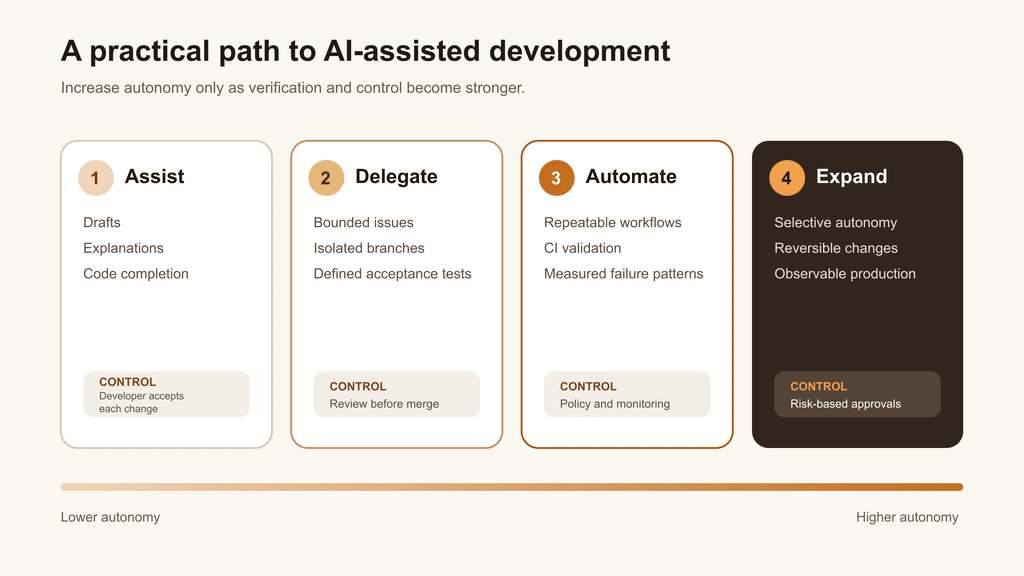
Businesses do not need to choose between banning AI and giving agents unrestricted control. A staged adoption model is safer and usually more effective.
1. Assist
Use AI for explanations, drafts, documentation, test suggestions, and developer-controlled code completion. Every change follows the existing review and deployment process.
2. Delegate Bounded Tasks
Allow coding agents to handle well-scoped issues in isolated branches or sandboxes. Define acceptance criteria, restrict permissions, run automated checks, and require review before merging.
3. Automate Repeatable Workflows
Automate tasks such as dependency updates, test maintenance, routine migrations, codebase cleanup, and initial bug investigation. Monitor accuracy, cost, and failure patterns.
4. Expand Autonomy Selectively
Grant more autonomy only where the organization has strong tests, clear ownership, observable systems, reversible changes, and reliable incident response. High-impact actions should keep proportionate approval gates.
Questions Leaders Should Ask Before Reducing Engineering Staff
Before treating AI as a replacement strategy, ask:
- Who converts business goals into precise acceptance criteria?
- Who owns architecture across multiple generated changes?
- Who reviews security-sensitive code and dependencies?
- Can the agent work in an isolated environment with limited permissions?
- Are the tests independent, meaningful, and difficult to manipulate?
- Can every production change be traced, reviewed, and rolled back?
- Who responds when the generated system fails?
- Are we measuring business outcomes or merely code output?
If these questions do not have clear answers, removing engineering expertise is likely to increase business risk rather than reduce cost.
AI Is a Force Multiplier, Not an Operating Model
AI can make software development faster and more accessible. It can help experienced teams ship more, help smaller teams attempt larger projects, and reduce the time spent on repetitive work.
But a model does not provide product ownership, architecture, security governance, quality assurance, or accountability by itself. Those capabilities come from people and from the engineering system they design around the AI.
The strongest business case is not replacing developers. It is giving good developers better tools, creating faster feedback loops, and focusing human attention on the decisions that determine whether software creates value.
Five Bricks combines experienced product engineering with AI-assisted workflows to build web applications faster without treating quality, security, or maintainability as optional. If you are evaluating an AI-enabled product or want to modernize your development process, contact our team to discuss a practical delivery approach.
Frequently Asked Questions
AI will automate parts of software development and change the skills developers use most often. Businesses will still need people to define requirements, design systems, manage risk, review outcomes, and take responsibility for production software.
A prototype or simple internal tool may be generated largely with AI. Production applications still require clear product ownership, security controls, testing, deployment, monitoring, and maintenance. The level of human engineering oversight should increase with the application’s business impact.
No. Research published in 2026 shows large gains in coding activity and task completion, but much smaller gains at the release level. Productivity depends on the task, codebase, tool generation, developer experience, and quality of the surrounding workflow. AI can accelerate implementation while poor context, weak review, or slow delivery processes consume part of that gain.
Common examples include prototypes, boilerplate, routine tests, documentation, repository search, migrations, refactoring assistance, and initial debugging. Sensitive or irreversible changes require stronger human review.
An AI coding harness is the system around a model that manages context, tools, execution, permissions, memory, tests, review, and feedback. It turns raw model capability into a controlled development workflow.