
Building a custom web application in 2026 typically requires a budget of $25,000 to $250,000 or more. A focused application with one core workflow may sit near the lower end. A multi-role platform with complex integrations, reporting, security requirements, and high traffic can move well beyond the upper end.
That range is wide because a web application is not a standard product. The cost depends on what users need to accomplish, how many systems the application must connect to, and how much operational risk the software carries.
This guide explains the main cost drivers, realistic project tiers, ongoing expenses, and the questions to answer before requesting an estimate.

Web Application Cost at a Glance
The following ranges are useful for early planning. They are not fixed quotes. Discovery can move a project into a different tier once the workflows, integrations, and security requirements are clear.
| Project type | Typical scope | Planning range | Typical timeline |
|---|---|---|---|
| Focused application | One core workflow, limited user roles, basic administration, one or two integrations | $25,000-$60,000 | 8-14 weeks |
| Mid-size business platform | Several workflows, multiple roles, dashboards, payments or third-party integrations | $60,000-$150,000 | 3-6 months |
| Complex or enterprise application | Advanced permissions, many integrations, large data volumes, compliance, high availability | $150,000-$300,000+ | 6-12+ months |
These figures assume professional product design, engineering, testing, deployment, and project management. A prototype built to test one idea may cost less. A regulated platform or a product expected to serve thousands of concurrent users may cost substantially more.
What Counts as a Web Application
A marketing website mainly presents information. A web application allows users to complete tasks and work with data. Examples include:
- customer portals;
- booking and scheduling systems;
- custom CRM or operations platforms;
- subscription products;
- inventory and order management tools;
- reporting dashboards;
- marketplaces;
- internal workflow automation.
The difference matters when comparing estimates. A polished company website with a contact form and CMS is not priced like a platform with authentication, several user roles, approval workflows, billing, audit logs, and real-time reporting.
How Complexity Changes the Budget
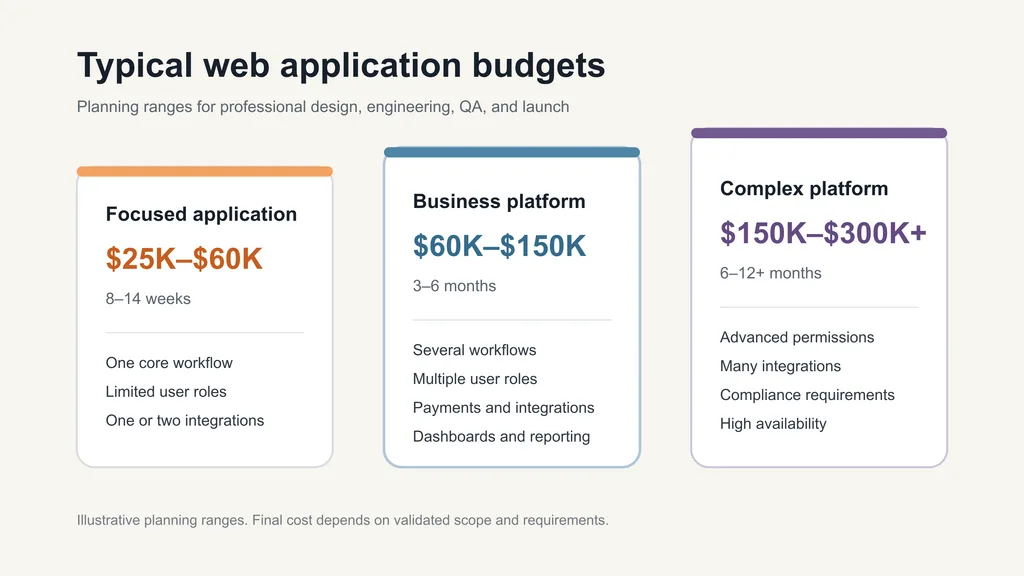
The number of pages or screens is a weak measure of application complexity. Ten screens that display static data can be simpler than three screens that coordinate payments, inventory, permissions, and an external API.
Focused Applications
A focused application solves one defined problem. It may support a single user type, a straightforward database, basic authentication, and a small administration area.
Common examples include a quote request portal, a lightweight scheduling tool, or an internal dashboard that replaces a spreadsheet. The project can remain near the lower cost tier when the workflow is stable and third-party dependencies are limited.
Mid-size Business Platforms
A mid-size platform often supports customers, employees, and administrators. It may include role-based access, notifications, file handling, payments, analytics, and integrations with a CRM, accounting system, or inventory service.
At this level, product decisions become more important. Teams need to define permissions, error states, data ownership, and the behavior of each integration. Quality assurance also takes longer because one change can affect several connected workflows.
Complex and Enterprise Applications
Complex applications may process sensitive information, serve multiple organizations, or support business-critical operations. Requirements can include single sign-on, detailed audit trails, tenant isolation, data migration, advanced reporting, high availability, and formal security controls.
Security work should be part of the development lifecycle rather than a final checklist. The NIST Secure Software Development Framework recommends integrating secure development practices throughout the software lifecycle to reduce vulnerabilities and address their causes.
Seven Factors That Drive Web Application Development Cost
Product Discovery and Scope
Development becomes expensive when the team starts coding before the business rules are understood. Discovery turns a broad idea into user roles, workflows, priorities, technical constraints, and acceptance criteria.
A short discovery phase adds cost at the beginning, but it reduces the risk of building the wrong feature or repeatedly changing completed work. It also produces a more reliable estimate.
User Experience and Interface Design
Design costs depend on the number of workflows, device types, and interaction states. A dashboard needs more than an attractive home screen. Designers must account for loading, empty, error, success, permission, and mobile states.
Reusable components can reduce implementation time and keep the interface consistent. User testing is particularly valuable when the application changes an established business process or serves people with different levels of technical experience.
User Roles and Permissions
Every additional role increases the number of scenarios the team must design, build, and test. A customer, employee, manager, administrator, and external partner may see different data and perform different actions on the same record.
Permissions also affect security. The team must decide who can view, create, edit, approve, export, or delete information and what happens when access changes.
Integrations and Data Migration
Integrations often create more uncertainty than visible interface work. The cost depends on API quality, documentation, authentication methods, rate limits, data mapping, and error handling.
Migrating historical data adds another layer. Old records may contain duplicates, inconsistent fields, or values that do not fit the new data model. A responsible estimate includes time to inspect, clean, test, and reconcile the migration.
Backend Architecture and Infrastructure
The backend controls business rules, data storage, integrations, authentication, and background jobs. Architecture becomes more demanding when the application must handle traffic spikes, large files, real-time updates, multiple tenants, or strict recovery requirements.
Cloud services make infrastructure easier to provision, but they do not remove architecture decisions. The team still needs monitoring, backups, access controls, deployment automation, and a plan for scaling.
Security and Compliance
All production applications need secure authentication, authorization, dependency management, encrypted connections, and protection against common attacks. Applications in healthcare, finance, education, or other regulated fields may require additional controls and documentation.
Compliance affects product design, data storage, logging, vendor selection, testing, and operating procedures. It should be identified during discovery because adding it late can require structural changes.
Quality Assurance and Launch Readiness
Testing covers more than checking whether a button works. A professional QA plan may include automated unit tests, integration tests, end-to-end scenarios, cross-browser checks, responsive behavior, accessibility, performance, and security review.
Google recommends evaluating page experience across Core Web Vitals, mobile usability, secure delivery, and the clarity of the main content. Good scores alone do not guarantee rankings, but a usable and reliable experience supports both users and search visibility.
Where the Budget Goes
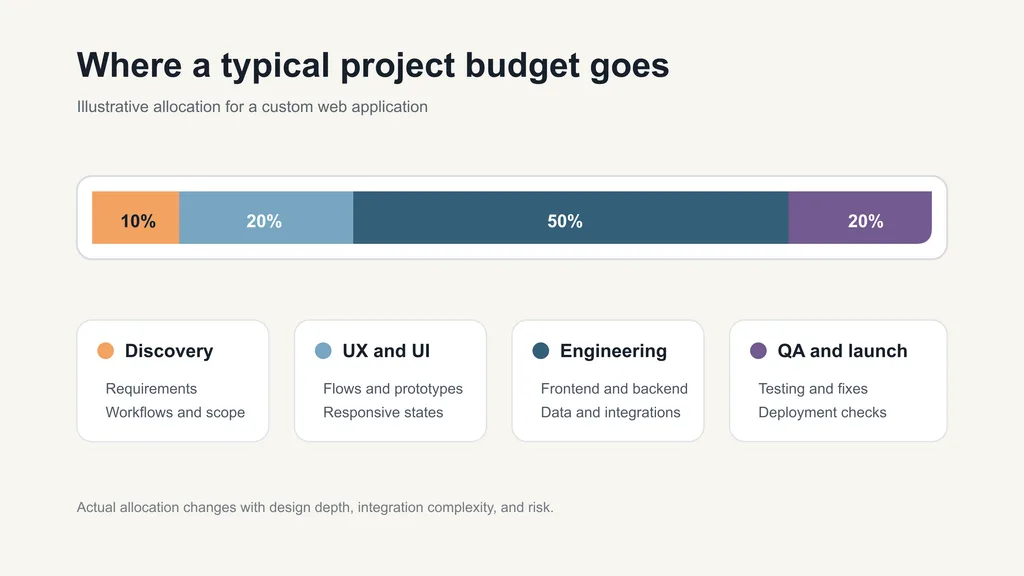
A typical custom application budget is distributed across several disciplines:
| Workstream | What it covers | Approximate share |
|---|---|---|
| Discovery and planning | Requirements, workflows, priorities, architecture | 10-15% |
| UX and UI design | Wireframes, prototypes, design system, responsive states | 15-25% |
| Engineering | Frontend, backend, database, integrations | 40-55% |
| QA and launch | Testing, fixes, deployment, release checks | 15-25% |
| Project management | Coordination, demos, documentation, risk management | Included across phases |
The allocation changes by project. An internal automation tool may need little visual design but significant integration work. A consumer subscription product may require deeper UX research and a more polished interface.
Costs That Continue After Launch
The launch budget is only part of the total cost of ownership. Plan for:
- cloud hosting, storage, email, monitoring, and other infrastructure;
- third-party subscriptions and API usage;
- security updates and dependency maintenance;
- bug fixes and browser or operating system changes;
- customer support and operational administration;
- analytics, performance improvements, and new features.
A common planning approach is to reserve 15-25% of the initial development budget per year for maintenance and incremental improvement. A stable internal tool may require less. A growing SaaS product may invest much more because development continues after the first release.
Fixed Price Versus Time and Materials
Fixed Price
A fixed price works when the scope is stable, the acceptance criteria are precise, and unknowns are limited. It gives the buyer budget certainty, but changes usually require a new estimate or change request.
Time and Materials
Time and materials works better for evolving products, complex integrations, and projects where user feedback will shape priorities. The client pays for the capacity used and can adjust the backlog as the team learns.
Phased Engagement
Many businesses benefit from a phased model: fixed or capped discovery, a defined first release, and then ongoing development in sprints. This creates a decision point before the largest investment and keeps the product flexible after launch.
How to Get a More Accurate Estimate
An agency can provide a useful range faster when you bring clear information. Prepare:
- The business problem and the measurable result you want.
- The primary user types and the tasks each user must complete.
- The systems the application must integrate with.
- Existing data that needs to be migrated.
- Security, compliance, and geographic requirements.
- The target launch window and any hard deadlines.
- The features that are essential for the first release.
Screenshots, sample reports, current spreadsheets, and short workflow recordings can be more useful than a long feature wish list. They show how the work happens today and where the real friction sits.
How to Reduce Cost Without Weakening the Product
Start with one valuable workflow. A smaller first release is easier to estimate, test, and improve. It also reveals whether users adopt the product before the team invests in secondary features.
Use established services for commodity capabilities such as payments, email delivery, identity, and file storage when they meet the requirements. Custom engineering should focus on the workflow that differentiates the business.
Keep one product owner available to answer questions and approve decisions. Delayed feedback creates idle time and rework. Regular demonstrations help stakeholders see working software before assumptions become expensive.
Do not remove testing, security, or discovery simply to lower the proposal. Those cuts may reduce the initial quote while increasing operational risk and post-launch cost.
Warning Signs in a Web Application Quote
Be cautious when a proposal:
- gives one precise price before discussing users and workflows;
- omits discovery, QA, deployment, or project management;
- lists technologies without explaining why they fit the product;
- assumes every integration will work without investigation;
- does not define ownership of code, infrastructure, and accounts;
- provides no plan for maintenance, monitoring, or handover;
- promises an enterprise platform on the timeline of a simple website.
A credible estimate states its assumptions and exclusions. It should explain what can change the budget and how the team will handle new information.
Planning Your Project with Five Bricks
Five Bricks develops websites, web applications, e-commerce products, and custom business systems. The process starts with research and discovery, followed by architecture, UX and UI design, development, QA, launch, and ongoing support.
That sequence is designed to make the estimate more reliable before the largest part of the development budget is committed. It also gives the client regular opportunities to review working software and adjust priorities.
If you are planning a custom application, share the workflow, required integrations, and first-release priorities. Five Bricks can review the requirements and prepare an initial scope and budget range.
Frequently Asked Questions
A professionally designed and developed application with one focused workflow often starts around $25,000. A small prototype can cost less, while production requirements such as integrations, administration, security, and testing can increase the budget.
A focused first release often takes 8-14 weeks. Mid-size platforms commonly require 3-6 months. Complex products may take 6-12 months or continue through ongoing releases.
AI-assisted tools can speed up some research, coding, testing, and documentation tasks. They do not remove the need to define workflows, make architecture decisions, verify security, test integrations, or validate the product with users. Treat productivity gains as part of the delivery approach, not as a substitute for product engineering.
Usually not. A responsive web application works in a mobile browser, but a separate native iOS or Android app introduces additional design, engineering, testing, release, and maintenance work.
A useful starting point is 15-25% of the initial development cost per year. The actual amount depends on usage, infrastructure, third-party changes, security requirements, support expectations, and the pace of new feature development.
Start with a short discovery conversation about the users, workflow, integrations, risks, and desired business outcome. This is enough to identify the likely project tier and the work needed for a dependable estimate.